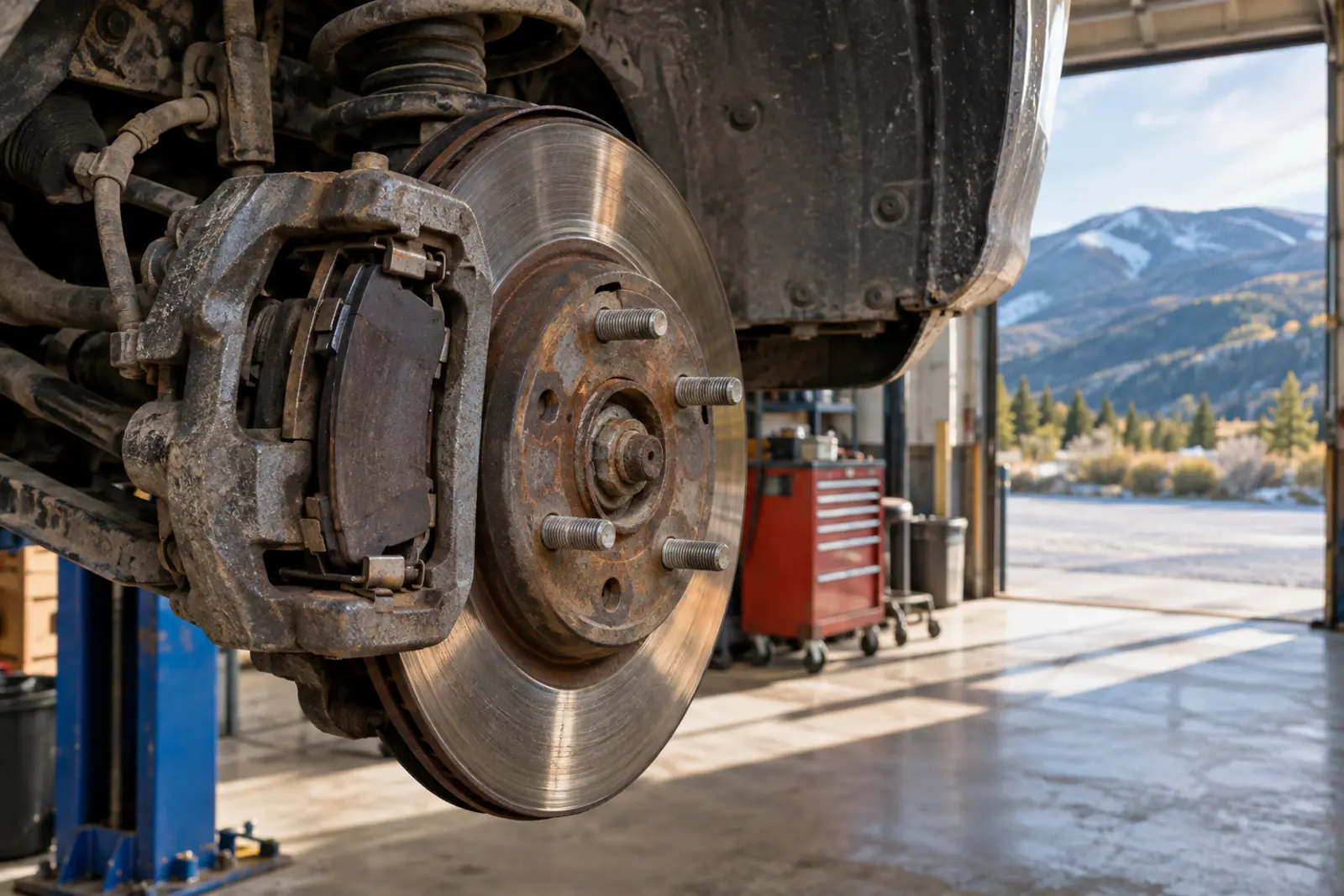
Brake fade on mountain descents is a loss of stopping power caused by heat: pads, rotors and brake fluid get hotter than they can handle on a long grade, so the pedal feels hard or spongy and the car slows less than it should. The fix is to let the engine and transmission do most of the slowing. Shift to a lower gear before the grade steepens, hold a steady speed and use the brake pedal only to top up. In Grand County, where US-40 climbs to Berthoud Pass at roughly 11,300 feet and Trail Ridge Road tops out at 12,183 feet, brakes are not a part to economize on.
What causes brake fade on a long grade
Brakes turn motion into heat. A heavy vehicle coming down a long grade at highway speed has to shed an enormous amount of energy, and the heat has nowhere to go. Sustained or repeated braking on a long, steep grade overheats the braking surfaces, and several things can happen, often one after another.
- Pad fade (friction fade). The pad material overheats and gives off gas between the pad and rotor, which lowers friction. The pedal feels firm but the car does not slow as it should.
- Fluid fade (fluid boil). Brake fluid absorbs moisture over the years. Hot, wet fluid boils at a lower temperature, creating vapor that compresses. The pedal then feels spongy or sinks toward the floor.
- Rotor damage. Extreme heat can warp or crack rotors, leading to shudder under braking.
Heat also spreads. When one brake fades, the others carry more of the load, so they heat up and fade as well.
If the pedal gets soft or the car will not slow, ease off the brakes if safe, shift down, and look for a pullout or runaway ramp. Do not keep pumping a boiling system.
Does brake fade go away?
Pad fade usually does. Friction fade generally reverses once the brakes cool, and they then usually perform about as well as before, as the overview of brake fade on Wikipedia notes. Cooling takes time, so pull over somewhere safe and let the brakes rest instead of continuing down the grade on hot pads.
Two things do not simply go away. Long heat can glaze the pad surface, making it smoother and less effective, and cooling alone may not restore it; glazed pads may need light sanding or replacement. And if the pedal went soft because the fluid boiled, the pedal may firm up after cooling, but the fluid that boiled was probably wet or old. Have the brakes and fluid inspected before the next descent, not after.
How to avoid brake fade: technique that saves your brakes
- Gear down early. Select a lower gear at the top of the grade, not halfway down. Automatics usually have a manual or low mode, and many have paddle shifters or a downhill mode.
- Brake firmly, then release. A steady, firm application to drop speed, then release to let the pads cool, is gentler than constant light pressure. Applying the brakes periodically rather than continuously gives them time to shed heat.
- Leave more following distance. Snow, ice and wet pavement multiply stopping distance on grades.
- Use the same gear you used going up. A common rule of thumb for steep grades. If a car needed second gear to climb, it may need it going down.
- Watch for grade signs. They often suggest speeds and gear choices for the road ahead.
- Start the descent with cool, healthy brakes. Fresh fluid, pads with life left and calipers that move freely are the best prevention. The altitude page explains why cooling and other systems work harder at elevation as well.
Downshifting on long grades
Downshifting makes the engine resist the wheels, which holds speed without heating the brakes. Pick the gear so the car holds a safe, steady speed with little or no pedal. If you are still speeding up in a given gear, shift one lower; do not wait for the speed to build and then brake hard to recover it.
In an automatic, use the manual mode, the low range (often marked L, 2 or 1) or the paddle shifters, and choose a gear the engine can hold without over-revving. On a manual transmission, the same gear that worked for the climb is a sensible starting point. Do not coast in neutral: it removes engine braking entirely and puts everything on the brakes.
Electric and hybrid vehicles slow through regenerative braking, which behaves differently when the battery is full or very cold. Read the owner's manual for the specific downhill setting.
Parts that matter most
| Part | What to check | Typical service guidance |
|---|---|---|
| Brake fluid | Moisture content and age | Many manufacturers recommend replacement every two to three years; check the manual |
| Pads | Thickness, glazing, uneven wear | Replace when worn to the minimum; always replace in axle sets |
| Rotors | Thickness, scoring, heat spots, runout | Replace if below minimum thickness or warped |
| Calipers and slides | Sticking pistons, seized slide pins | Winter salt can seize them; clean and lubricate at pad changes |
| Brake lines and hoses | Rust, cracks, bulges | Inspect each fall; rusted steel lines can fail suddenly |
Brake fluid boiling point: dry vs wet
Most passenger cars use DOT 3 or DOT 4 fluid. The federal standard for motor vehicle brake fluids (FMVSS No. 116) sets a minimum dry boiling point of 205 °C (401 °F) for DOT 3 and 230 °C (446 °F) for DOT 4. The wet boiling point, which describes fluid that has absorbed moisture, is far lower: at least 140 °C (284 °F) for DOT 3 and 155 °C (311 °F) for DOT 4, according to the text of 49 CFR 571.116.
- DOT 3: 205 °C dry minimum, 140 °C wet minimum.
- DOT 4: 230 °C dry minimum, 155 °C wet minimum.
- DOT 5 (silicone-based): 260 °C dry minimum, 180 °C wet minimum. It is not interchangeable with DOT 3 or DOT 4.
These are minimums for new fluid in a standard test; real fluid in a car can differ, and the fluid keeps absorbing moisture as it ages. The drop of roughly 65 to 80 degrees between dry and wet is why age matters as much as the grade. Use the type printed on the reservoir cap or in the manual, and do not mix in silicone-based DOT 5 fluid. If you tow, haul a camper or live where you cross passes often, ask a shop to test the fluid rather than relying on the calendar alone.
Choosing pads for steep country
- Ceramic pads. Quiet, clean and gentle on rotors, with good everyday performance. Most drivers do well with them.
- Semi-metallic pads. Tolerate heat better and give a strong bite, but they wear rotors faster and can be noisy.
- Original equipment pads. A safe baseline, because they were matched to the vehicle's weight and brakes.
Tow, plow or carry heavy loads? Look for pads and rotors rated for higher temperatures, and check the vehicle's towing section in the manual. Part labels are covered in the guide to OEM, aftermarket, used and remanufactured parts. To get the right pad or rotor for your exact trim, see how to find car parts by VIN, and note that remanufactured calipers are often sold with a deposit explained in the guide to core charges, returns and warranties. Brakes are a place where counterfeit parts exist, so buy from a traceable source; see how to spot fake auto parts websites.
Winter and salt: the hidden brake killers
Road treatments that contain chlorides get into calipers, slide pins and brake lines. A caliper that sticks causes uneven wear and heat. Rinse the underside regularly through the winter and have the brakes inspected at the start and end of the season. The guide to road deicers and underbody rust explains how to do that. A good set of winter tires also matters for stopping, as the guide to winter tires and the traction law describes. Brakes belong on the seasonal list in the winter car care checklist for mountain drivers.
Signs your brakes need attention now
- A soft, spongy or sinking pedal.
- Grinding, which can mean pads worn through to metal.
- Vibration through the pedal or steering wheel during braking.
- The car pulling to one side when you brake.
- A brake warning light, or a burning smell after a descent.
- Fluid on the inside of a wheel.
Do not postpone these. Brake repair is one of the few jobs where the price of waiting can be an accident.
Frequently Asked Questions
Is it better to use low gear or the brakes on a long hill?
Use both, in the right proportion. A lower gear holds speed with engine braking, and the brakes handle the rest. Using the brakes alone on a long, steep grade is the way to overheat them.
Does brake fade go away?
Pad fade normally fades away as the brakes cool, and they perform about as before. Glazed pads and wet or old fluid may not recover with cooling alone, so have the system inspected after any episode where the pedal went soft.
How often should brake fluid be changed?
Many manufacturers recommend every two to three years, but intervals differ, so follow your manual. Drivers who tow or cross high passes often should consider testing the fluid and replacing it sooner.
What does brake fade feel like?
The pedal feels hard or spongy and the car slows less than usual even with firm pressure. A burning smell often goes with it. If it happens, shift down, slow down where it is safe and let the brakes cool.
What is the boiling point of brake fluid?
Under the federal standard, new DOT 3 fluid must boil no lower than 205 °C (401 °F) and DOT 4 no lower than 230 °C (446 °F). Once the fluid has absorbed moisture, the minimums fall to 140 °C (284 °F) and 155 °C (311 °F).
Do electric vehicles need different brake care?
They use regenerative braking, which reduces wear on pads, but the friction brakes still need cleaning and inspection, especially where salt is used. Rarely used brakes can rust, so exercise them with a few firm stops from time to time.
Should I replace pads and rotors together?
Often, but not always. Rotors that are above minimum thickness and in good condition can sometimes be reused with new pads. Many shops recommend replacing both for the best result, and pads should always be replaced in pairs on an axle.