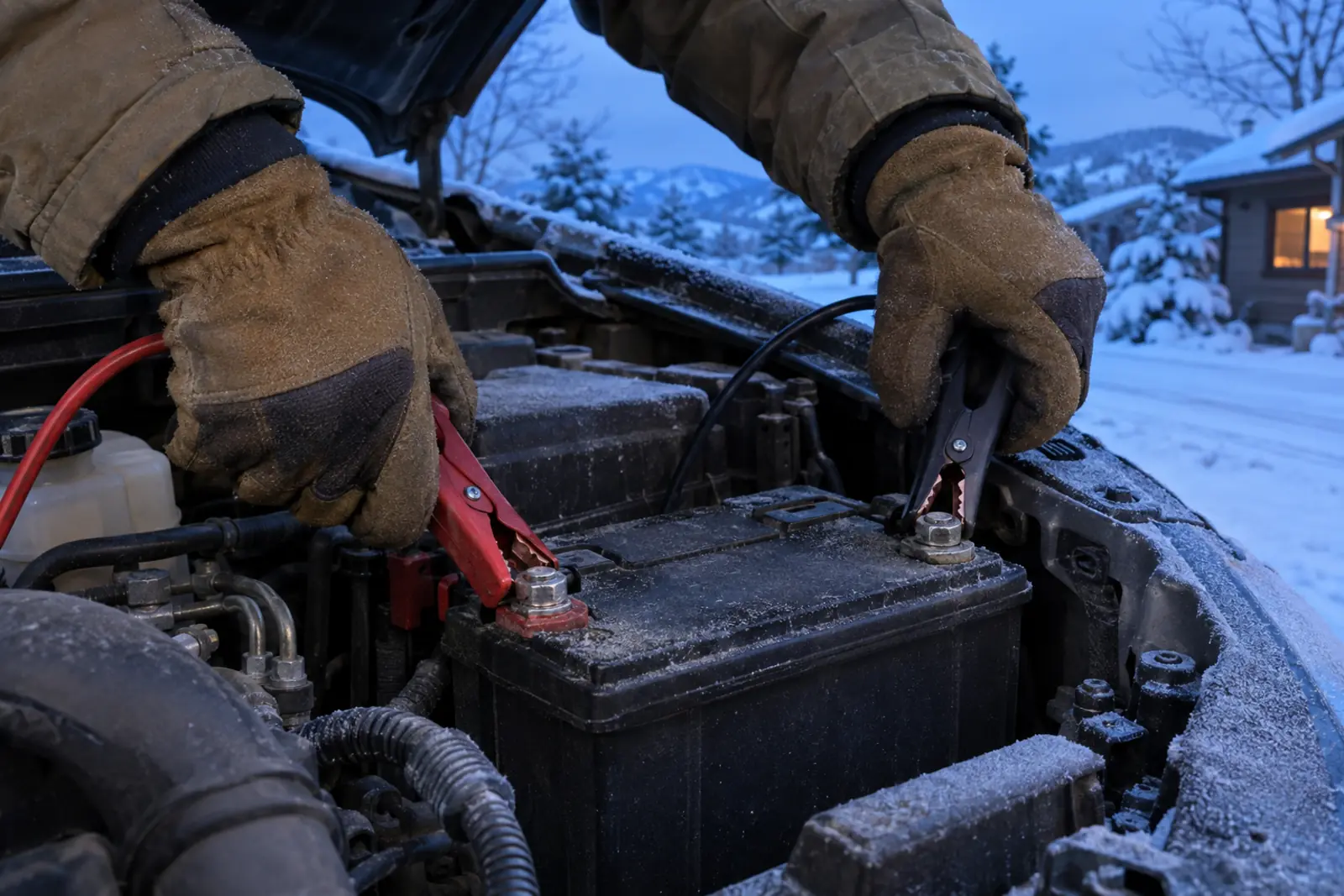
Cold weather does not kill a car battery so much as expose a weak one. A battery delivers less current in the cold at the very moment the engine needs more of it, because oil is thick and the starter has to turn it over. For a mountain winter, choose a battery whose cold-cranking amps (CCA) meet or exceed your vehicle manufacturer's specification, test it each fall, and replace it before it fails rather than after. Batteries commonly last about three to five years, and less when they are used hard or left partly charged.
How cold weather affects a car battery
A lead-acid battery produces power through a chemical reaction, and that reaction slows as the temperature falls. The battery can still be fully charged and yet deliver noticeably less current at 0°F than at 70°F. Meanwhile, engine oil thickens and the starter works harder. Short trips make it worse, because the alternator has little time to put back what the starter took out. Granby sits at roughly 8,000 feet in a high basin with long, cold winters, so a battery that was marginal in October can leave you stranded in January.
Cold exposes damage more than it causes it. Heat is the bigger long-term enemy: according to AAA, heat speeds up the chemical reactions that wear a battery out, so batteries in cooler northern climates often last five years or more, while hot southern climates often see about three. Battery University, citing a Battery Council International study from 2010, reports an average starter-battery age of 59 months in the cooler North against 47 months in the warmer South. A summer of under-hood heat can quietly use up capacity that a cold January morning then reveals.
A deeply discharged battery also faces a freezing risk. The electrolyte in a battery with a low charge contains less sulfuric acid, and the lead-acid battery article on Wikipedia notes that this makes it more likely to freeze in a cold environment. Keeping the battery charged is part of keeping it safe.
Cold cranking amps explained: CCA, reserve capacity and group size
| Rating | What it means | Why it matters in the cold |
|---|---|---|
| CCA (cold-cranking amps) | The current a battery can deliver at 0°F (about -18°C) for 30 seconds while holding a minimum voltage | The best single number for cold starting; meet or exceed the vehicle specification |
| Reserve capacity | How many minutes the battery can run a basic load if the alternator fails | Matters on remote roads where help is far away |
| Group size | The physical size, terminal layout and polarity | Determines whether the battery fits the tray and cables |
| Date code | When the battery was made or shipped | An older battery on the shelf has already spent some of its life |
CCA is measured at 0°F, which is why it is the standard measure for cold-climate shopping. In the standard definition, the battery must still hold at least 7.2 volts after 30 seconds at the rated current. A higher CCA than the specification is fine as long as the group size matches, but never go below it: AAA advises against installing a battery rated lower than the manufacturer's recommended CCA. Use the VIN-based method in the guide to finding parts by VIN to confirm the group size.
Do not confuse CCA with "cranking amps" (CA) or "marine cranking amps" (MCA). Those are measured at 32°F, a warmer and less demanding test, so the numbers are always higher for the same battery. AAA warns that cranking amps produce inflated figures. When you compare batteries for a cold climate, compare CCA to CCA.
AGM vs flooded battery in cold weather
- Standard flooded batteries. The most common and generally the least expensive. They work well for ordinary vehicles in good condition.
- AGM (absorbent glass mat). Sealed, more resistant to vibration and deep discharge, and often required in vehicles with start-stop systems. They tend to cost more.
- Lithium and specialty batteries. Sometimes used in performance applications. Check compatibility before replacing the original type.
If your car came with an AGM battery, replace it with an AGM battery. Fitting a cheaper flooded type can cause charging problems in vehicles that expect the original chemistry. AAA gives the same rule: match the battery type (conventional lead-acid or AGM) and the group number to the original. Deep discharge is where AGM earns its extra cost, since Wikipedia describes AGM batteries as more tolerant of deep discharge, but more expensive. The same source notes that deep discharge, such as leaving the lights on, can shorten the lifespan of a low-maintenance battery by a third or more.
Typical retail ranges for a replacement battery run from about $120 to $300 or more for most cars, with AGM at the higher end, but prices change, so verify before you shop.
How to test a car battery before the cold arrives
- Know the age. Look for the date code on the case. AAA recommends an annual test once a battery reaches its third year. In a Granby winter, do it in the fall, before the first hard freeze.
- Get a load test. Many parts retailers and repair shops test batteries for free or for a small fee. A voltmeter reading alone does not show how a battery behaves under load.
- Measure resting voltage. With a multimeter on DC volts, read across the terminals after the car has sat unused. Battery University gives these 12-volt starter-battery readings at about 78°F after a 24-hour rest: 12.65 V is 100% charged, 12.45 V about 75%, 12.24 V about 50% and 12.06 V about 25%. The battery should rest at least four hours after driving or charging, and manufacturers recommend 24 hours for lead-acid, because a reading taken right after use is misleading. Cold lowers the reading, so treat a fall measurement as a rough guide, not a verdict.
- Check the terminals. Clean off white or blue-green corrosion with a baking soda and water mix and a brush, then reconnect firmly.
- Check the cables, clamps and hold-down. A loose clamp mimics a dead battery. AAA also notes that loose or missing hold-down hardware can significantly shorten battery life through vibration.
- Test the charging system. A weak alternator will wear out a good battery. A shop can test the alternator output at the same time.
A battery reading near 12.65 V at rest is only charged, not necessarily healthy. A worn battery can show a normal resting voltage and still collapse when the starter draws current, which is why the load test comes first.
Signs a battery is failing
- The engine turns over slowly, especially on cold mornings.
- Headlights dim when you start the car.
- A clicking sound without the engine turning.
- A battery warning light, or electronics resetting.
- A swollen or cracked case. Replace the battery right away.
Habits that make a battery last longer
- Take longer drives now and then. Short hops from the driveway do not recharge the battery fully.
- Switch off accessories before shutting the engine down.
- Park in a garage if you can. Even a modest amount of shelter helps.
- Use a battery maintainer on vehicles that sit for weeks, such as a second home vehicle or a seasonal truck. AAA notes that a parked car self-discharges and that a maintenance charger can extend service life.
- Inspect the battery and its connections at every oil change, as AAA suggests.
- Use an engine block heater on the coldest nights. It eases the load on the battery by warming the engine.
Jump-starting in the cold
A frozen battery should not be jump-started. If the case is bulging or you see ice, stop and call for help. Otherwise, connect the cables as the owner's manual directs, normally positive to positive, then negative on the donor to an unpainted metal ground on the stalled car, away from the battery. Let the donor run for a few minutes before trying to start. If a battery has run flat once, have it tested, because deep discharge shortens its life. Keep a set of good-quality cables, a portable jump pack, a blanket and warm clothes in the car. The winter checklist for Grand County drivers lists other items worth carrying.
Where to buy and what to ask
National retailers, tire shops and dealer parts counters all sell batteries. Ask for the manufacturing date, the warranty terms (the free-replacement period is usually shorter than the pro-rated one), and the core charge. AAA suggests buying from a high-volume seller so the stock is fresh, and looking for a warranty that offers free replacement for three or more years. The guide to core charges and warranties explains how the old-battery return works. If you are weighing a store-brand battery against the original-equipment brand, the comparison of OEM, aftermarket and remanufactured parts covers the trade-offs. When ordering a heavy battery online, read how to spot a fake auto parts website before you pay.
Frequently Asked Questions
How many CCA do I need for a mountain winter?
Meet or exceed the CCA in your owner's manual or the vehicle's original specification. Going somewhat higher gives extra margin in extreme cold, provided the group size matches and the battery fits securely.
How long does a car battery last in cold climates?
Commonly three to five years, though it varies with the battery, the vehicle's charging system and how you drive. AAA says cooler climates often get five years or more. A battery in its fourth year deserves a test every fall.
Can a battery be fine in summer and fail in winter?
Yes. Heat damages a battery internally during the summer, and the cold then reveals the loss of capacity. A battery that seems fine in August can fail on the first below-zero morning.
What is the difference between CCA and cranking amps?
CCA is the current a battery can deliver at 0°F for 30 seconds. Cranking amps (CA) are measured at 32°F, an easier test, so the figure is always higher. For cold-climate shopping, use CCA.
What voltage means a car battery is weak?
At rest, a healthy 12-volt starter battery reads about 12.6 V when fully charged. Per Battery University, 12.24 V is about half charged and 12.06 V about a quarter. A reading in that range means the battery needs charging and then a load test.
How often should I test my car battery?
AAA recommends testing once a year after the battery's third birthday, and inspecting the battery and connections at each oil change. In Grand County, fall is the best time, before the first deep freeze.
Is it worth buying an AGM battery?
If the vehicle came with AGM or has a start-stop system, yes, replace it with the same type. In other vehicles it is optional and costs more, though it can handle deep discharge better.
Should I disconnect the battery if the car sits all winter?
A battery maintainer is a better choice for most vehicles, since disconnecting can reset electronics. Follow the owner's manual for long storage, and keep the battery charged, because a discharged battery can freeze.