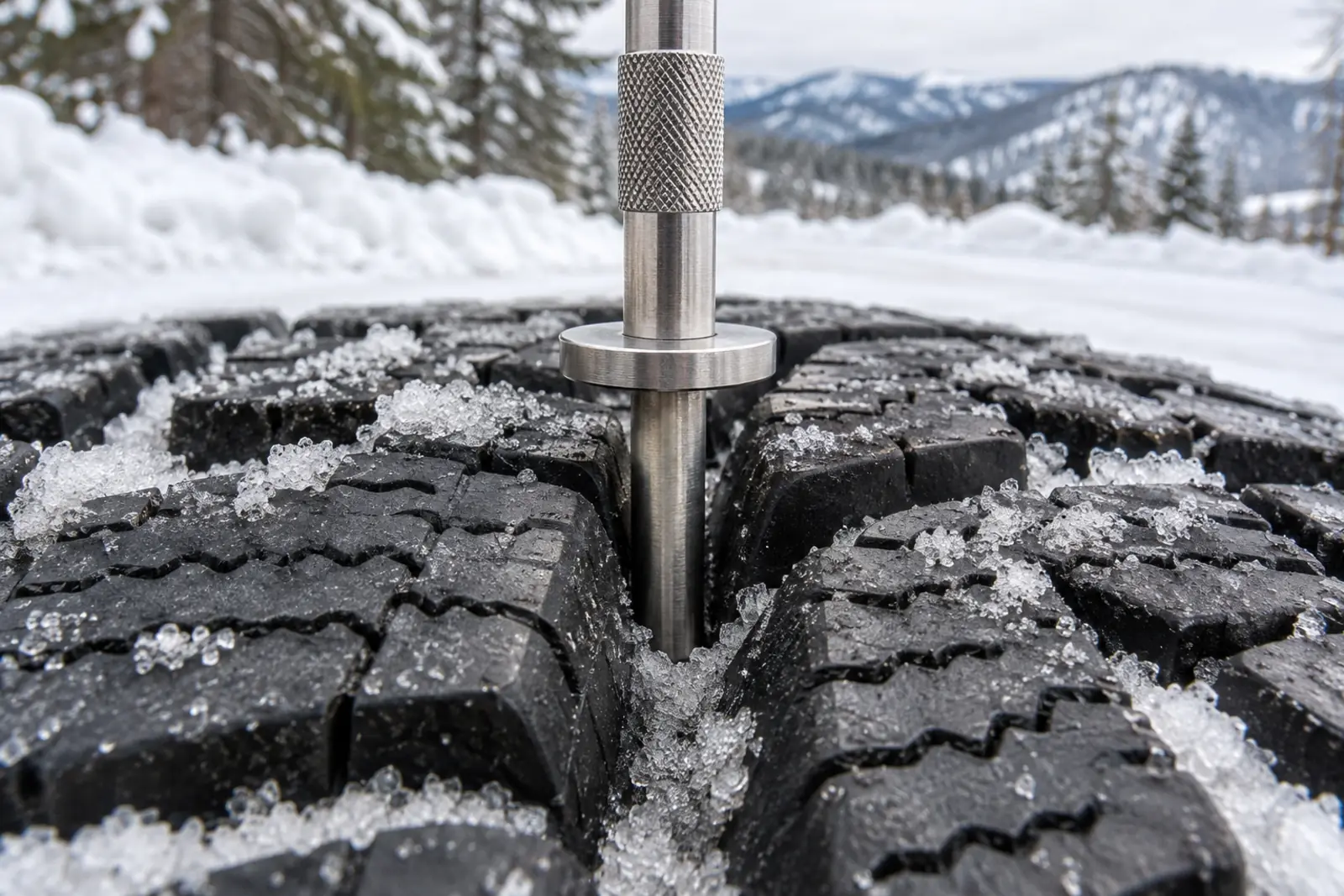
Under Colorado's Passenger Vehicle Traction Law, a car needs tires with at least 3/16 inch of tread that are rated all-weather or winter (marked with the mountain-and-snowflake symbol, M+S or M/S), or it needs chains or an approved alternative traction device. Four-wheel or all-wheel drive is not required, although the Colorado Department of Transportation (CDOT) highly recommends it in the mountains. The same tire rule applies to two-wheel-drive cars and SUVs, and a rental car is treated like any other passenger vehicle. For daily winter driving around Granby and Grand County, dedicated winter tires are the best traction upgrade you can buy. This page explains the rules as published by CDOT and how to choose.
What the Traction Law and the Chain Law say
CDOT describes two levels for passenger vehicles. Rules and fines can change, so check CDOT's traction law page and COtrip before a trip.
| Level | When it applies | What a passenger vehicle needs |
|---|---|---|
| Passenger Vehicle Traction Law | CDOT lists I-70 between Morrison and Dotsero from September 1 to May 31, or whenever conditions require; it can also be put in place on any state highway | Tires with at least 3/16 inch tread that are all-weather or winter-rated (mountain-snowflake, M+S or M/S), or chains or an approved alternative traction device |
| Passenger Vehicle Chain Law | Severe storms, as the last step before a highway closure | Every vehicle must have chains or an approved alternative traction device |
Because US-40 over Berthoud Pass is a state highway, CDOT can apply these laws there when conditions call for it. Do not assume that the law only matters on I-70.
How to know whether the law is in effect
According to CDOT, an active Traction Law or Chain Law is announced through highway signs, COtrip.org and traffic and road condition alerts. You can also call 511 for current road information. CDOT offers text and email alerts through its COtrip subscription page, which is useful if you cross a pass regularly. On I-70 the law is listed as in force from September 1 to May 31, so on that corridor your tires need to qualify all winter whether or not it is snowing.
Colorado traction law for passenger vehicles: AWD, 4WD and 2WD
The law is written around tires and traction devices, not drivetrain. CDOT's FAQ says all-wheel-drive and four-wheel-drive vehicles meet the Traction Law if all of their tires have the minimum 3/16 inch of tread. A two-wheel-drive car or pickup is also legal when its tires meet the tread and rating rule, or when it carries chains or an approved device. Drivetrain affects how well a vehicle gets moving. It does not change what the law asks of the tires.
Colorado traction law for a rental car
CDOT's traction law pages do not describe rental cars separately. The rules describe the vehicle and its tires, so a rental has to meet them like any other passenger vehicle. Before you leave the lot, check the tire sidewalls for the mountain-snowflake symbol or M+S/M/S marking and look at the tread. Rental cars often wear all-season tires, which can qualify on paper but grip poorly on ice. If you plan to cross a pass in winter, ask the rental company what tires the car has and whether its agreement allows chains or traction devices, because the agreement is where that is decided.
Penalties
CDOT's page lists a $100 fine plus a $33 surcharge for non-compliance, and $500 plus a $157 surcharge if non-compliance results in the closure of a travel lane. According to CDOT's FAQ, the Colorado State Patrol enforces both laws as secondary offenses, meaning a driver can be cited only if they crash or cause a traffic delay while not compliant. Older news reports quote other numbers, so rely on the agency pages. The bigger cost is practical: a stuck vehicle can block a pass for hours, and a tow from a mountain highway is expensive.
Colorado traction law tread depth: how to check 3/16 inch
- Use a gauge. A tread depth gauge costs a few dollars and takes seconds. The law's 3/16 inch equals 6/32 inch, which is deeper than the 2/32 inch commonly cited as the point where a tire is worn out.
- Use a coin. Put a quarter into the groove with Washington's head upside down. If the top of the head is fully visible, the tread is about 4/32 inch or less, which is below the Colorado requirement. A coin can show that a tire fails, but it cannot confirm 6/32 inch, so use a gauge when the tire looks borderline.
- Check across the tire. Uneven wear shows in the center, the edges or on one side. The requirement applies to the tires on the vehicle, so measure every one, including the one that looks fine.
- Look at the sidewall. Cracks and bulges mean the tire needs to be replaced regardless of depth.
Winter tires vs. all-season vs. all-weather
- Winter (snow) tires. Soft rubber that stays flexible in cold temperatures and tread designed to grip snow and ice. They carry the mountain-snowflake symbol. Best traction, shortest stops on snow and ice.
- All-weather tires. A compromise that also carries the mountain-snowflake symbol and can be driven all year. Better in snow than a basic all-season, not quite a dedicated winter tire.
- All-season tires. Designed for mild winter conditions. Many carry only the M+S marking, which describes tread design rather than performance in a standardized snow test. They may meet the legal rule, but they give up grip in deep cold and on ice.
CDOT's FAQ lists winter, all-weather and M+S tires as safe winter options that stop faster in winter conditions than regular all-season tires. Rubber compounds in many all-season tires harden in sustained cold, while winter compounds stay supple. In a basin where winter temperatures often drop far below freezing, that matters more than the label. All-wheel drive helps you get moving; it does not help you stop or turn. Tires do that.
Do you need four winter tires?
Yes. Fitting winter tires on only the front or only the rear axle can upset the vehicle's balance, so tire shops generally recommend a full set of four, and CDOT's FAQ also says to replace all four tires rather than two. CDOT does not recommend running winter tires year-round, so a second set of wheels makes seasonal swaps quick and protects the good tires from winter damage. Typical price ranges for a set of four winter tires vary widely with size and brand, from a few hundred to well over a thousand dollars; check current prices with the retailer.
Chains and traction devices
Carry chains or an approved alternative device if you cross passes in winter, even with good tires. Under the Chain Law every vehicle, regardless of its tires, must have them. Practice installing them at home, in daylight, because a roadside stop in a storm is a poor classroom. Make sure your vehicle's manual permits chains and on which axle; some low-clearance cars cannot take them. CDOT's approved products list includes cable chains and fabric-type traction devices; the page names products such as AutoSock, EasySox, ISSE Tire Sock and Alpha Trax, and the full list is on CDOT's Approved Products List. Keep gloves, a mat to kneel on and a flashlight with them. See the winter checklist for Grand County drivers for the rest of the emergency kit.
Tire pressure in the cold
Tire pressure falls as the temperature drops, commonly by about 1 psi for each 10°F. A tire that reads correctly on a warm afternoon may be noticeably low on a subzero morning. Check cold pressure with a gauge and inflate to the figure on the door-jamb placard, not the number molded into the sidewall. More on that is in the guide to altitude, engines, cooling and tire pressure.
Other parts that matter on a winter pass
Tires are only part of staying in control. Long descents on snow put heavy load on the brakes, which is covered in the guide to brakes for mountain descents. Salt-spray and deicer film on the windshield is a visibility problem in its own right; see the notes on winter wipers and washer fluid. Magnesium chloride on the road also ends up on the underbody, so it is worth reading how road deicers affect rust and underbody care.
Frequently Asked Questions
Is all-wheel drive enough to meet Colorado's Traction Law?
According to CDOT, four-wheel or all-wheel drive is not required, and the requirement is about tires or traction devices. CDOT's FAQ says AWD and 4WD vehicles comply when all tires have at least 3/16 inch of tread. CDOT highly recommends AWD or 4WD in the mountains, but check the tread and rating on every tire.
What is the minimum tread depth for the Traction Law?
CDOT lists 3/16 inch of tread. That is deeper than the 2/32 inch figure usually cited as the legal wear limit for normal driving, so a tire can be legal elsewhere and still not meet the Traction Law.
Do M+S tires meet the requirement?
CDOT lists tires marked M+S, M/S, or with the mountain-snowflake symbol, with enough tread. For better performance in real snow and ice, choose a tire with the mountain-snowflake symbol.
When does the Traction Law apply?
CDOT lists I-70 between Morrison and Dotsero from September 1 to May 31, or when conditions require, and it can be applied on any state highway. Check COtrip or CDOT's page before you travel.
Does the Colorado Traction Law apply to rental cars?
CDOT's pages do not single out rental cars, and the rules apply to passenger vehicles and their tires. Treat a rental like your own car: check the tire marking and tread before driving into the mountains, and read the rental agreement about chains.
Can a two-wheel-drive car drive on I-70 when the Traction Law is on?
Yes, if its tires meet the 3/16 inch tread and all-weather, winter or M+S rating, or it carries chains or an approved alternative traction device. Drivetrain is not the test. Under the Chain Law, though, every vehicle needs chains or an approved device.
Can I use studded tires in Colorado?
Rules for studs are set by state law and may restrict use by season or by type, so check current Colorado regulations with CDOT or the state patrol before buying. This guide leaves the details out because they can change.