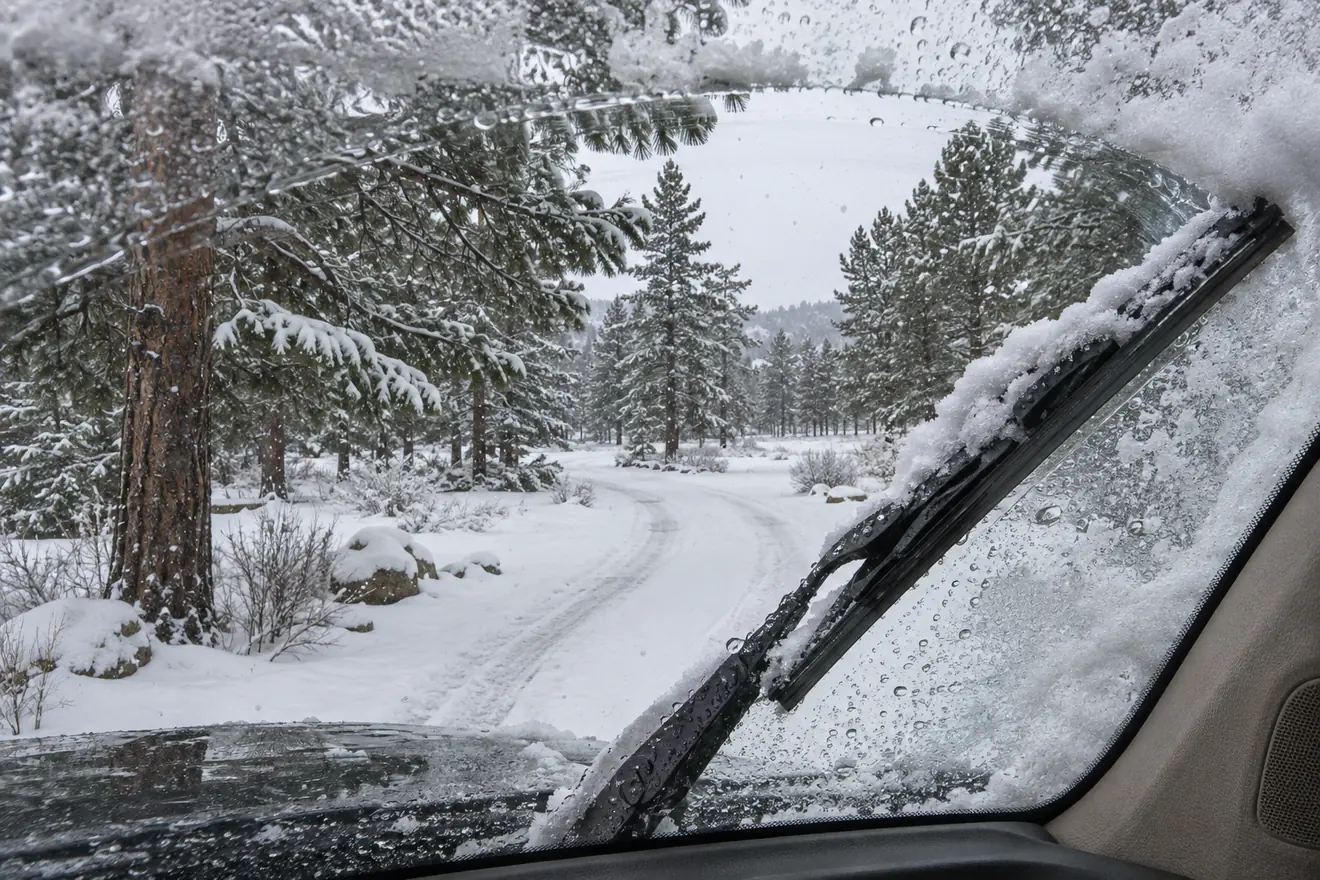
For mountain winters, fit winter-style wiper blades with a protective rubber boot, fill the reservoir with washer fluid rated for well below freezing, and replace blades at least once a year. Ice, packed snow, road spray and low sun all compete for your view, and wipers are the cheapest visibility upgrade on any vehicle. This guide covers blade types, washer fluid, and the small habits that keep a windshield usable between Granby and the passes.
Why mountain winters are hard on wipers
Several things combine in a high, cold basin. Blades freeze to the glass overnight, snow packs into the hinges of ordinary frame blades, and road spray from treated pavements leaves a film that smears. Early and late sun sits low on the horizon in winter, and a dirty windshield turns glare into a blinding haze. Rubber also stiffens in the cold and wears out faster against ice and grit.
Blade types compared
| Type | Strengths | Weaknesses | Winter fit |
|---|---|---|---|
| Conventional frame | Inexpensive, widely available | Exposed joints collect ice and snow; uneven pressure | Poor |
| Winter blade (rubber-boot frame) | Boot keeps snow and ice out of the joints | Slightly bulkier; can be less sleek at speed | Good |
| Beam (flat) blade | Even pressure, low profile, resists ice buildup | Costs more; wrong size cannot be fixed with adapters | Good to very good |
| Hybrid | Streamlined cover over a frame | Mid-priced; quality varies | Good |
Look up the correct lengths for the driver and passenger side separately, and the rear wiper if you have one. Using your VIN in a catalog, as described in the guide to finding parts by VIN, avoids the classic wrong-size mistake.
When to replace blades
- Streaks, smears or a hazy band that does not clear.
- Chattering or skipping across the glass.
- Cracked, split or hardened rubber.
- A bent frame or a blade that lifts at one end.
Many drivers replace blades once a year, in fall, before the first heavy snow. Replacing only the rubber inserts is possible on some blades and saves money, though the whole blade is simpler for most people. Inexpensive blades are commonly adequate, but pay a bit more for a good winter blade if you spend much time on the highway.
Washer fluid: the label that counts
Plain water freezes in the lines and can crack the reservoir. Washer fluid made for winter lists a freeze point on the bottle, and mountain drivers should look for the lowest one on the shelf. Check the temperature rating, not the color. A few notes:
- Do not mix water into winter fluid unless the label permits it. Dilution raises the freeze point.
- Do not use engine coolant, soap or household cleaners in the reservoir. They can damage paint, rubber and the pump.
- Carry a spare jug in the car, because spray from trucks and treated roads can empty a reservoir in a single trip over a pass.
- If the system freezes anyway, park in a warm spot and wait. Do not run the pump against a frozen line, which can burn out the motor.
Wiper habits for cold mornings
- Clear the glass first. Run the defroster and use a scraper, never the wipers, to remove ice and snow.
- Turn wipers off before shutting down. Otherwise they may try to move when the car starts, even when frozen to the glass, which can blow a fuse or strip a linkage.
- Do not pull on a frozen blade. Warm the glass until it releases.
- Lift the arms away from the glass before a heavy snowfall, if your vehicle's manual allows it. Fold them back down before driving.
- Clean the blades. Wipe the rubber edge with a cloth and washer fluid or rubbing alcohol to remove the grit that smears the glass.
The glass itself
A film on the inside of the windshield, often caused by plastics and cabin materials, also hurts winter visibility. Clean the inside with an automotive glass cleaner and a fresh microfiber cloth. Replace the cabin air filter if your defroster fogs easily. Chips and cracks matter too, because cold temperature changes can make a small chip spread across the windshield. Repair a chip promptly. Whether insurance covers it depends on your policy, so check with the insurer.
Visibility also depends on lights. Clear snow off headlights and taillights, and replace dim bulbs before winter. Heated mirrors, a working rear defroster and good tires, as covered in the winter tires and traction law guide, complete the picture. Other seasonal items are in the Grand County winter parts checklist.
Rain-repellent treatments
Water-repellent glass coatings make rain and sleet bead and roll off the windshield. Some drivers find them helpful at highway speed in winter. They can cause wiper chatter if applied poorly or on dirty glass, so follow the label and wipe the glass thoroughly first. Never use them as a substitute for good blades.
Frequently Asked Questions
How often should I change wiper blades?
About once a year is a common rule, and sooner if they streak, chatter or crack. In mountain areas with harsh winters and grit, fall replacement is a reasonable habit.
Are winter wiper blades worth it?
For mountain winters, usually yes. The rubber boot over the frame keeps ice and packed snow out of the joints so the blade keeps pressing evenly. Beam-style blades have a similar advantage.
What temperature rating should washer fluid have?
Look for the lowest freeze point offered on the label, comfortably below the coldest overnight temperature you expect. Fluid rated only for light frost is not enough for a high mountain basin in January.
Why does my washer fluid freeze even though it says winter?
The reservoir may hold leftover water or summer fluid that diluted the mix. Drain it and refill with the right fluid, and make sure the lines and nozzles are not blocked.
Can I use hot water to defrost the windshield?
It is risky. A sudden temperature change can crack cold glass, especially if there is already a chip. Use the defroster, a scraper or a de-icing spray designed for car glass instead.