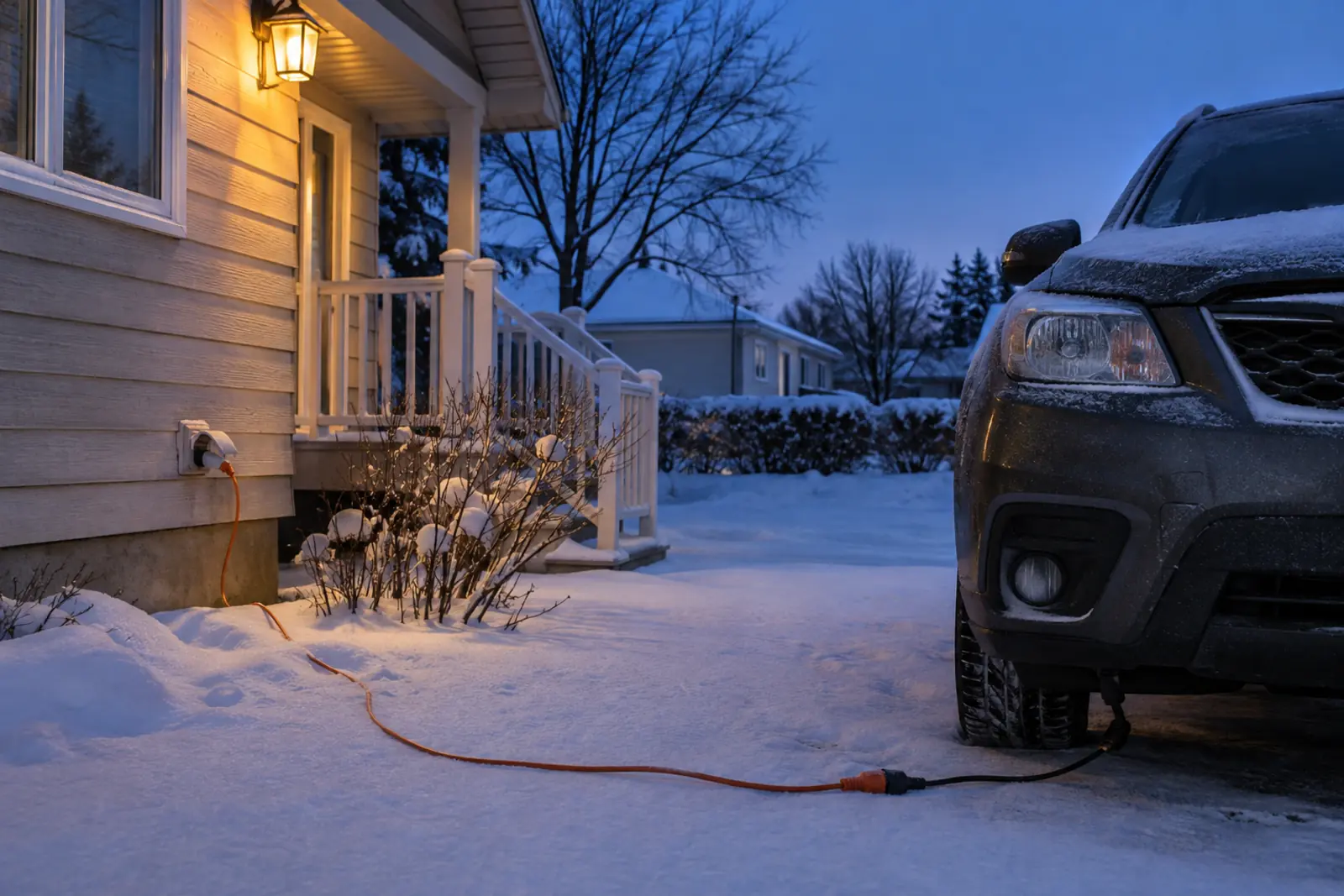
An engine block heater is an electric heater that warms your engine's coolant (or oil) while the car is parked, so the engine starts more easily and reaches operating temperature sooner. Plug it in about two to four hours before you leave, ideally through a timer, on nights that fall around 0°F or colder. Test results summarized on Wikipedia's engine-heater page found little extra benefit from running a heater beyond about four hours. Check whether your vehicle already has one, since many trucks sold in cold regions do, and ask a qualified installer before adding one.
Do you need a block heater in Granby?
Granby sits at roughly 7,900 feet, and its January mean daily minimum is about 1°F, according to the climate table on Wikipedia's Granby, Colorado page. That means a typical January night is already near the point where many drivers start plugging in. Whether you actually need a heater comes down to four things:
- Where the vehicle sleeps. A vehicle parked outdoors through subzero nights benefits most. A heated garage makes a heater largely unnecessary.
- Engine type. Diesel engines are harder to start cold and benefit sooner than gasoline engines. Gasoline engines generally need less help, but a warm start still means less warm-up fuel use.
- Short trips. The U.S. Department of Energy's fueleconomy.gov reports that conventional gasoline cars lose about 15% fuel economy in city driving at 20°F compared with 77°F, and up to 24% on trips of three to four miles. Engines that start warm spend less time in that penalty.
- Battery condition. A heater eases the load on a weak battery, but it does not replace a healthy one. See the guide to batteries in extreme cold for testing and replacement.
Why cold starts are hard on engines
A cold engine is thick with cold oil, and the oil takes a short while to reach every bearing and cam lobe. Fuel does not vaporize well in the cold, so the engine runs rich until it warms up, which washes some oil from cylinder walls. The battery delivers less current, as the guide to batteries in extreme cold explains. A block heater attacks all of these problems at once by starting the engine already warm.
Types of engine heaters
| Type | How it works | Pros | Cons |
|---|---|---|---|
| Freeze-plug (core plug) heater | An element replaces one of the engine's freeze plugs and heats coolant directly | Efficient, factory-style, common on trucks | Installation can be labor-intensive |
| Hose-type (inline) heater | Warms coolant in a hose and circulates it by convection | Fits where there is no freeze-plug access | Needs careful hose routing and clamps |
| Oil pan heater | A pad or element warms the oil pan | Easy to fit; good for oil flow | Does not warm the coolant directly |
| Dipstick heater | An element in the dipstick tube heats the oil | Inexpensive and simple | Heating is limited |
| Battery blanket | Wraps the battery in a heating pad | Helps cold cranking | Does not warm the engine |
Many modern vehicles have no factory block heater, and some should not have one added. A competent installer or a dealer can tell you what suits your engine. Typical parts prices run from modest for a dipstick or pad heater to higher for a quality block heater with installation, but verify the price for your vehicle.
Heater kits are specific to the engine, so match the part by engine code or VIN before you buy; the guide to finding car parts by VIN shows how. Whether to choose a factory-brand or aftermarket element is the same trade-off covered in OEM vs aftermarket parts. If you are buying a used engine, ask whether the heater element is included and intact; the checks for a used engine or transmission list what else to verify.
How long to plug in a block heater
Two to four hours before you leave is enough for most engines. The Wikipedia engine-heater article, summarizing a 1972 Canadian agricultural-engineering study, reports that coolant warmed by almost 20°C (36°F) in the first four hours regardless of the starting temperature, and that two more hours added only up to about 3°C (5°F). The engine oil warmed by only about 5°C (9°F) over the same period. Those tests ran at ambient temperatures from about -20°F to 12°F.
A timer makes this effortless: set it to switch on about four hours before your usual departure. Heating all night adds cost without much benefit.
To estimate the cost, multiply the wattage on the heater's label by the hours it runs and divide by 1,000 to get kilowatt-hours. For example, a 1,000-watt heater running four hours uses 4 kWh; multiply by your local rate per kWh.
How to use one safely
- Use a timer. Two to four hours before departure is plenty for most engines. Leaving a heater on all night adds cost without much benefit.
- Use a proper outdoor-rated extension cord. The cord should be rated for the load and for cold weather, as short as practical, and with a grounded plug. A damaged or undersized cord is a fire hazard.
- Plug into a grounded outlet, ideally one with ground-fault protection.
- Inspect the cord each fall. Look for cracks, exposed wire and bent prongs.
- Unplug before you drive off. Drive-away accidents with cords still attached damage cars and garages. Hang the cord from the mirror or the wiper as a reminder.
Block heater cords and extension cords
The block heater cord is the short plug end that usually exits through the grille; the extension cord runs from there to the outlet. Both take the abuse, because cold makes cord jackets stiff and prone to cracking.
- Match the cord to the heater. Read the wattage on the heater label and choose an outdoor-rated, cold-weather extension cord rated above that load. Do not chain several cords or use a thin indoor cord.
- Keep the cord out of the way. Route it so it cannot touch the exhaust, belts, fan or other moving parts, and so the wheels cannot run over it.
- Replace, do not tape. A cord with a cracked jacket, exposed wire or burned plug should be replaced. Electrical tape on a damaged cord is not a safe repair. Replacement block heater cords are sold by vehicle, so match the part to your engine.
- Warm plug or tripped breaker. A plug that feels hot, or a ground-fault outlet that keeps tripping, means stop using the setup until the cord, heater and outlet are checked.
To confirm a heater is working, plug it in for an hour or so and carefully feel the coolant hose or block near the element; it should be noticeably warmer than a similar spot elsewhere. If nothing warms, suspect the cord, the outlet or the element.
Oil, fuel and fluids for cold starts
- Oil viscosity. Use the grade in your owner's manual. A lower first number in a multigrade oil, such as 0W or 5W, flows better when cold. Do not guess; the manual lists acceptable grades for your engine.
- Synthetic oils. Many flow better in extreme cold than conventional oil, and they are often the specified type in modern engines.
- Diesel fuel. Diesel can thicken or gel in extreme cold. Suppliers in cold regions typically sell winter-blend diesel, and anti-gel additives exist. Ask your fuel supplier and check your owner's manual.
- Coolant. Test the mix before winter. Freeze protection depends on the antifreeze-to-water ratio, and a shop or parts counter can test it for a small fee.
Starting technique
- Turn off the heater, lights and other loads before turning the key.
- Start the engine and let it idle for only a short time, usually about thirty seconds to a minute, until oil pressure is established and the RPM settles.
- Drive gently. A modern engine warms much faster under light load than it does idling.
- Do not rev a cold engine.
- For diesels with glow plugs, wait for the indicator to go out.
Extended idling wastes fuel and is not necessary. Fueleconomy.gov notes that idling gets 0 miles per gallon and that most manufacturers recommend driving off gently after about 30 seconds. Remote starters are convenient but run the engine while you stand inside, so use them for a minute or two rather than ten.
Other parts that suffer in deep cold
- Belts and hoses. Rubber stiffens and cracks. Replace worn ones before winter. See the winter parts checklist.
- Glow plugs and spark plugs. Weak ignition parts show up as hard starting first.
- Fuel filter and fuel lines. Water in fuel can freeze. Fuel-line antifreeze products exist, but check your vehicle's requirements.
- Thermostat. A thermostat stuck open keeps the engine and heater cold. Related cooling issues are in altitude, engines, cooling and tire pressure.
Is a block heater worth it?
It depends on how cold your mornings get, how long you park outside and how the engine is built. For a vehicle that sits outdoors through subzero nights, it is a sensible, inexpensive precaution that helps starting, cabin heat and fuel economy. For a garaged vehicle, the benefit is smaller. For a trailer queen sitting for weeks, a battery maintainer matters more. If you are unsure, ask your dealer whether a heater is available for your engine.
Frequently Asked Questions
How long should I plug in a block heater?
Two to four hours is enough for most engines, and a timer saves electricity. Running it all night rarely adds much benefit.
At what temperature should I use a block heater?
Many drivers start using one when temperatures fall to about 0°F or below, and some earlier. Diesel engines benefit sooner than gasoline ones. Your owner's manual may give a recommended threshold.
Can I install a block heater myself?
Some kinds, such as dipstick and pad heaters, are simple to fit. Freeze-plug heaters involve draining coolant and are better left to a shop unless you have experience. Wiring errors are dangerous, so be careful.
Does a block heater use a lot of electricity?
Most draw a few hundred watts to about a thousand, so a few hours on a timer is modest. Costs depend on local rates, so check the heater's wattage on its label and use watts times hours divided by 1,000 to get kilowatt-hours.
Will an electric vehicle need a block heater?
No, but electric vehicles often benefit from preconditioning while plugged in, which warms the battery and cabin using grid power. Fueleconomy.gov notes that preheating the cabin while plugged into the charger can extend range. Check your owner's manual for how to schedule it.
Can I just idle the engine instead of using a block heater?
Idling is a poor substitute. It burns fuel at 0 miles per gallon, and most manufacturers recommend driving off gently after about 30 seconds. A block heater warms the engine without running it, and gentle driving then warms the rest of the drivetrain.
Is it safe to leave a block heater plugged in overnight?
A heater in good condition on a grounded outlet is generally safe, but it wastes electricity because the benefit levels off after about four hours. A timer gives the same result for less. If the cord is damaged or the outlet trips, do not leave it running unattended.
Does a block heater help a weak battery?
Only indirectly. A warm engine turns over more easily and puts less load on the starter and battery, but a heater does not recharge or repair a weak battery. A battery blanket or a maintainer targets the battery itself.