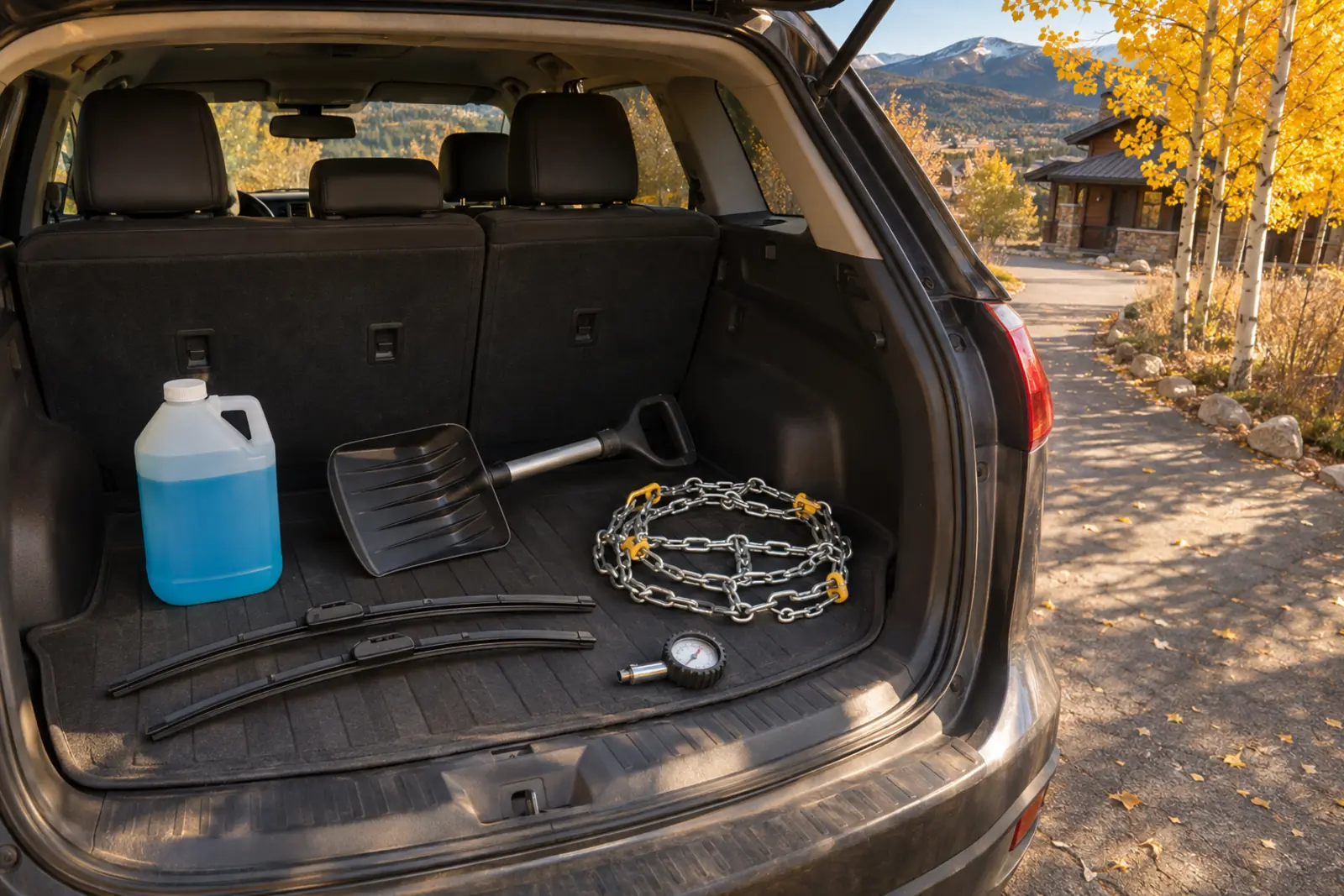
A winter car care checklist for mountain driving comes down to six jobs, best done in early fall before the first storm: test the battery, check tires and tread, replace wiper blades and fill the washer reservoir with low-temperature fluid, inspect brakes and brake fluid, test the coolant, and pack a winter emergency kit. Repeat a lighter version in spring to wash off the winter's residue. This page ties the other guides on this site into one seasonal plan.
Why a seasonal plan beats reacting
In a high mountain basin, a failure in January is more than an inconvenience. Highway passes close, tow response can be slow and cell service drops in places. Granby sits at roughly 8,000 feet with long, cold winters, and nearby routes such as US-40 over Berthoud Pass reach about 11,300 feet. Trail Ridge Road, which reaches 12,183 feet, closes for the season, usually from mid-to-late October until late May. A few hours of preparation in October prevents most winter breakdowns.
Fall car maintenance before winter
Work through the table below in order of failure risk: starting and stopping first (battery, brakes, tires), then visibility and cooling. Each row links to the guide that explains the details.
| System | What to do | See |
|---|---|---|
| Battery | Load test; clean terminals; check the date code; replace if weak or past about four years | Batteries in extreme cold |
| Tires | Measure tread (3/16 inch is the Traction Law figure); fit winter or all-weather tires; set pressure when cold | Winter tires and the traction law |
| Wipers and washer | New winter blades; fluid rated for very low temperatures; spare jug in the car | Winter visibility |
| Brakes | Inspect pads, rotors, lines; test or replace old fluid; check for sticking calipers | Brakes on descents |
| Cooling system | Test coolant freeze point; check hoses, cap and thermostat | Altitude and cooling |
| Engine starting | Verify the block heater and cord; correct oil grade; fresh fuel and filter | Block heaters and cold starts |
| Underbody | Inspect lines and frame; touch up chips; consider a corrosion coating | Deicers and rust |
| Lights | Replace dim bulbs; clean lenses; check brake and signal lights | This page |
| Heat and defrost | Replace cabin air filter if airflow is poor; check that the defroster is working | This page |
Winter car care tips for the cold months
Maintenance does not stop once the checklist is done. A few habits through the season keep small problems from becoming roadside ones.
- Keep the tank well filled. A fuller tank leaves a margin if a closure or crash delays you for hours, and Ready.gov advises keeping a full tank of gas in winter.
- Wash off road treatment. On a milder day, rinse the underbody and wheel wells, since deicer residue keeps working on metal after the roads dry.
- Watch the first starts after a cold night. Slow cranking is an early warning that the battery is weak; get it tested before it leaves you stranded.
- Keep washer fluid topped up. Road spray empties the reservoir quickly, and a dirty windshield at low sun is dangerous.
- Re-check tire pressure after cold snaps, because pressure drops as the air cools.
The winter emergency kit
Ready.gov's basic winter vehicle kit is jumper cables, sand, a flashlight, warm clothes, blankets, bottled water and non-perishable snacks. A mountain kit adds the items below.
- Chains or an approved alternative traction device, with gloves and a kneeling mat. CDOT's traction law page describes what is approved.
- Jumper cables or a portable jump starter.
- Blanket or sleeping bag, warm hat, gloves and boots.
- Flashlight with spare batteries, or a headlamp.
- Ice scraper, snow brush and a small shovel.
- Traction aid such as sand or cat litter.
- Water and non-perishable snacks.
- Phone charger and, if you travel remote roads, a paper map. Coverage can drop on mountain routes.
- First-aid kit and any needed medications.
- Reflective triangles or flares.
- Spare washer fluid and a small bottle of de-icer for locks and glass.
If you get stuck in snow
Ready.gov's advice for a stranded driver is to stay inside the vehicle and stay off the road if at all possible. Keep the exhaust pipe clear of snow and run the engine only briefly for warmth, with a window slightly open. Dress in layers, call for help and share your location.
Winter driving checklist for mountain trips
Run through this list before every winter trip, especially one that crosses a pass.
- Check the road conditions and any traction or chain law on COtrip before you leave. CDOT can apply the laws on any state highway.
- Fill the fuel tank to at least half, and fuller if you can; Ready.gov advises keeping a full tank in winter.
- Clear all snow and ice from the roof, hood, windows and lights.
- Check tire pressure; cold air lowers it.
- Tell someone your route and expected arrival.
- Pack the emergency kit and keep your phone charged.
Spring checklist
- Wash the whole vehicle thoroughly, including the underbody, wheel wells and door jambs.
- Inspect brake lines, calipers and the exhaust for winter damage.
- Rotate tires and check alignment, since potholes are hard on suspensions.
- Swap winter tires for summer or all-season tires if you use them, and store the winter set clean, cool and dry.
- Replace wiper blades that took a beating.
- Test the battery again, because winter strain can show up in spring.
- Check the air conditioning before summer.
Summer and shoulder seasons
Summer in the mountains is easy on batteries but hard on cooling systems and tires. Long climbs, heat and loads can push temperatures up, so check coolant, belts and tire condition before road trips. Strong sun at altitude ages rubber and plastic, and afternoon storms bring hail and slick roads. The shoulder seasons can bring snow without warning, so keep the winter kit in the vehicle until well into late spring.
Keeping records and buying parts wisely
Write the date and mileage of each service in a notebook or phone note. Keep receipts for batteries, tires and brake work, which also matter for warranty claims. When a part is needed, confirm the fit by VIN; see finding parts by VIN. For help deciding between part types, read OEM, aftermarket, used and remanufactured parts. If a replacement part carries a deposit, the guide to core charges, returns and part warranties explains how that works, and if a repair grows into an engine or transmission swap, see buying a used engine or transmission. Buy from sellers you can verify, as the guide on spotting fake auto parts websites explains.
Frequently Asked Questions
When should I winterize my car in Colorado's mountains?
Early fall, ideally by October. The CDOT Traction Law on I-70 is listed from September 1 to May 31, and mountain storms can arrive earlier than expected, so do not wait for the first snowfall.
What should I keep in my car in winter?
Chains or traction devices, jumper cables, a blanket, warm clothing, a flashlight, a scraper and shovel, water and snacks, a phone charger and a first-aid kit. Add any medications you need and a spare jug of washer fluid.
What should I check before driving over a mountain pass in winter?
Check COtrip for conditions and any traction or chain law, make sure the tank is well filled, clear all snow and ice from the car, confirm tire pressure and tread, and pack the emergency kit. Tell someone your route and expected arrival time.
How full should I keep the gas tank in winter?
As full as practical. Ready.gov advises keeping a full tank of gas in winter, which gives you fuel for the engine and heater if a closure or crash leaves you waiting for hours.
What should I do if I get stranded in my car in the snow?
Stay inside the vehicle, as Ready.gov advises, and call for help with your location. Keep the exhaust pipe clear of snow, run the engine only briefly with a window slightly open, and dress in layers.
How often should I check my tires in winter?
At least monthly, and after big temperature drops. Pressure falls roughly 1 psi for every 10°F, and cold, low tires wear poorly and grip worse.
Do I need a mechanic for the fall check?
You can do many items yourself, such as wipers, washer fluid, tire pressure and the emergency kit. For brakes, the battery load test, coolant testing and underbody inspection, a shop or parts retailer with proper tools is worth using.
Should I keep winter tires on all year?
Not usually. Winter compounds wear faster in warm weather and handle worse than summer or all-season tires when it is hot. Many drivers swap in spring and store the set for the next winter.