Buying a used engine safely comes down to four things: confirm the donor vehicle's identity, mileage and condition in writing; match the unit to your own vehicle by VIN; get a warranty that states exactly what it covers; and pay by a method that can be disputed. Never wire money to a stranger for a drivetrain part. A used engine or transmission can be a fair way to keep a good vehicle on the road, but the part is only one piece of the bill, because labor, fluids and related parts often cost as much as the unit itself.
First, decide whether it makes sense
A major drivetrain repair is a big decision. Compare the cost of a used unit, a remanufactured one and a replacement vehicle. The table gives the usual trade-offs.
| Option | Strengths | Risks |
|---|---|---|
| Used engine or transmission | Lowest part cost; original fit | Unknown history and wear; short warranty |
| Remanufactured unit | Rebuilt to spec; longer warranty is common | Higher cost; core charge; quality varies by rebuilder |
| New crate engine | Full warranty; known condition | Highest cost; not available for every model |
| Repair the existing unit | No swap labor if the fault is limited | May fail again if the damage is widespread |
| Replace the vehicle | Fresh start | Cost and loan; market conditions |
Prices vary by vehicle and region, so get written quotes for both the part and the labor. The guide to OEM, aftermarket, used and remanufactured parts explains the categories in more depth.
A simple test: add the used unit, installation labor, the parts replaced during the swap and a margin for surprises, then compare that total with what the vehicle is worth running. If the body, frame, axles or the rest of the drivetrain are tired, a good engine will not fix the vehicle.
Confirm it is the right unit
- Match using your VIN. Engines and transmissions differ by engine code, gear ratio, drivetrain and year. The guide to finding parts by VIN explains how to confirm what you need.
- Ask for the donor vehicle's VIN, year and mileage, and why it was scrapped. A unit from a low-mileage wreck is usually a better bet than one from a car that died of mechanical failure.
- Ask for photos of the actual unit with the engine code or serial number visible.
- Ask about accessories. Find out whether the price includes the intake, sensors, accessories and flywheel or torque converter, or whether you must transfer those from the old unit.
- Ask about testing. Some sellers run engines before removal, test compression or pressure-test a transmission. Ask what was done, and get it in writing.
Used engine or transmission: what to check
How you inspect depends on whether you can see the unit. In person, you can check it directly. At a distance, you rely on photos, video and paperwork, so the paperwork matters more.
Inspecting it before you buy
When you can see the unit in person, look for these signs.
- Engines: milky residue under the oil filler cap, sludge, metal flakes in the oil, heavy rust, cracks, damaged threads, or a crankshaft that does not turn by hand.
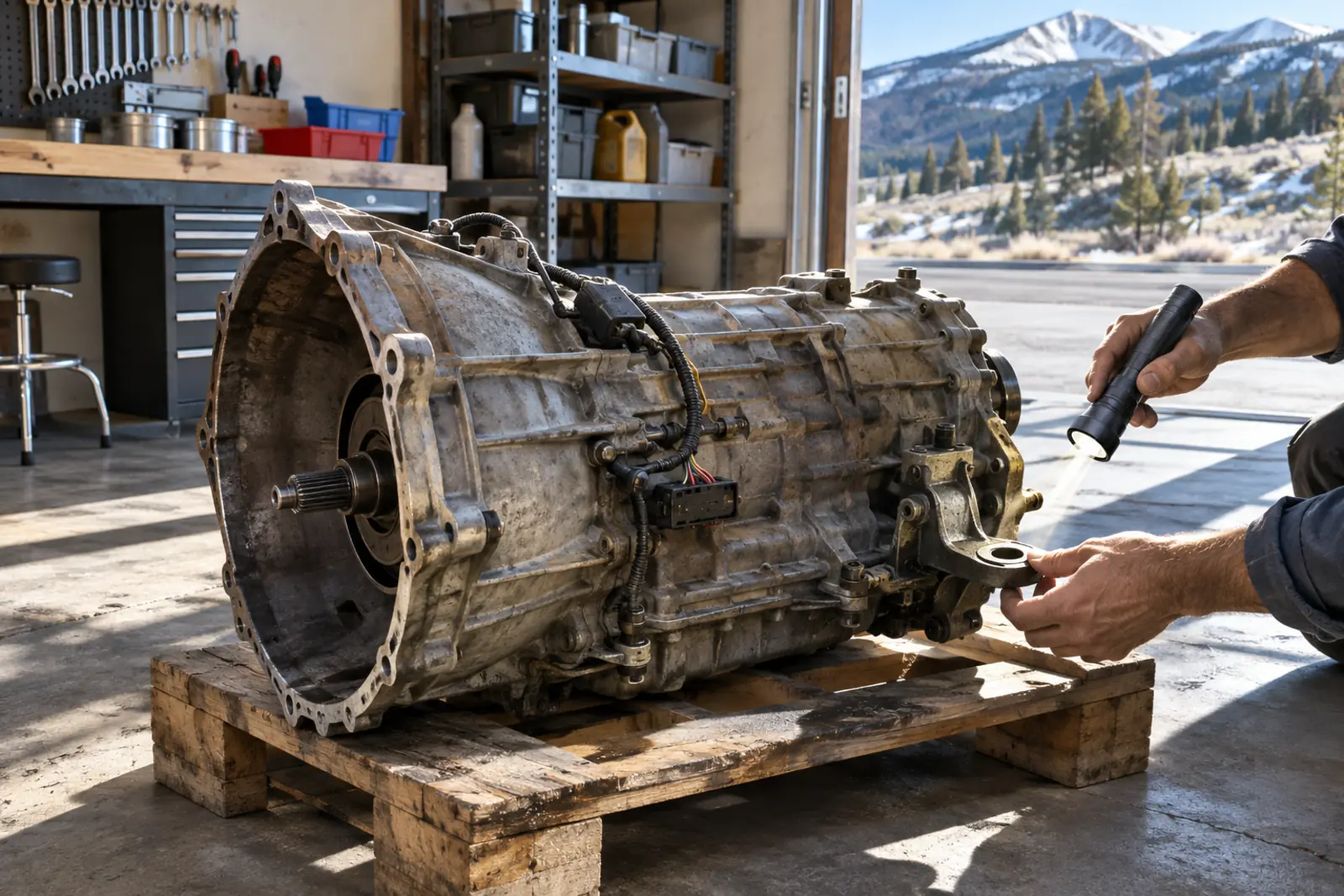
- Transmissions: dark, burnt-smelling fluid, metal in the pan, a torque converter that has been run dry, or a case with cracks or stripped bolt holes.
- Both: obvious collision damage near the unit, missing parts, mismatched plugs or fresh sealant that hides something.
If the seller is far away, ask for a video of the unit turning over or of the donor vehicle running before it was pulled. A short video proves little by itself, but a seller who refuses is telling you something.
Mileage matters, but history matters more
Low mileage on a donor vehicle is a good sign only if it can be supported. A seller can quote a number, but the unit itself cannot prove it. Prefer a donor with a known VIN, an odometer photo and, if possible, service records. A unit with moderate mileage and a documented history is often a better buy than a low-mileage unit with no paperwork.
Extra checks for a used transmission
Transmissions are harder to judge by eye than engines, so lean on fluid condition, the seller's testing and the warranty. Confirm that the unit matches yours exactly: automatic or manual, two-wheel or four-wheel drive, gear ratio and the electronic controls it needs. Ask whether the torque converter is included and whether the unit was drained and inspected. Some newer automatics depend on electronic controls, so ask the shop whether the replacement needs programming or a relearn procedure after installation.
Questions to ask the seller
- How many miles are on the donor vehicle, and how do you know?
- Was the engine or transmission tested, and how?
- What is the warranty period, and does it cover the part only or labor as well?
- If the unit fails, do I get a replacement, a refund or store credit?
- Who pays freight for the return of a defective unit?
- Is a core charge involved?
- What must I do to keep the warranty valid, for example installation by a licensed shop, fluid changes or the replacement of specific components?
Treat a refusal to put terms in writing as an answer. See core charges, returns and warranties for what normal terms look like. Salvage warranties are often short, commonly 30 to 90 days, and some parts are sold as is.
Used engine warranty: what to look for in the terms
A used engine warranty is only as good as its fine print. Read these points before you pay.
- What the remedy is. A replacement unit, a refund and store credit are three very different outcomes. If the remedy is a replacement, you may pay for a second installation unless labor is covered.
- When the clock starts. Coverage may run from the purchase date or the delivery date, not from the day the engine is installed. A swap that takes weeks can use up a short warranty before the engine ever runs.
- What voids it. Many warranties require installation by a licensed shop, an early oil change, a new water pump or specific components, plus receipts as proof.
- What is excluded. Accessories, sensors, overheating damage and wear items are commonly excluded or covered on shorter terms.
- How a claim works. Find out who must approve diagnosis, whether the unit must be removed and shipped back, and who pays freight.
Ask for the warranty terms in writing on the invoice or as a separate document, and keep a copy together with the order confirmation.
Avoiding fraud
High prices and urgency attract scammers. Be suspicious of anyone who wants payment by wire, gift card or a payment app, who will not give a physical address, or whose price is far under everyone else's. Search the seller's name with words such as review or complaint. The guide on how to spot fake auto parts websites has a full checklist, and the same rules apply to private sellers on marketplace listings.
The U.S. Federal Trade Commission lists cryptocurrency, wire transfers, payment apps and gift cards among the payment methods scammers insist on, and it advises against ever depositing a check and sending money back to the sender. It also notes that honest businesses give you time to make a decision, and that anyone who pressures you to pay is a scammer (FTC, How to avoid a scam).
Why a credit card is the safer way to pay
Pay by credit card where possible. Under the FTC's guidance on credit card disputes, a billing error such as a charge for an item you did not receive as agreed must be reported in writing so that it reaches the card issuer within 60 days after the first bill showing the error was sent to you (FTC, Using credit cards and disputing charges). Engines are often shipped on freight, so check the delivery date and the billing cycle, and file the dispute promptly if the unit never arrives.
Budgeting the whole job
Installing an engine or transmission is labor-intensive. Ask the shop for a written estimate that includes labor, fluids, gaskets and seals, and the parts that should be replaced while everything is apart, such as the water pump, belts, mounts, clutch and filters. A used engine installed with a worn cooling system can fail early, which is why the cooling system deserves attention, especially for a vehicle that climbs mountain passes. Ask whether the shop warrants its labor, and for how long, and remember that a part warranty and a labor warranty are different promises.
In cold country, plan for the first start as well. A freshly installed engine deserves a careful first cold start, and an engine block heater can make cold starts easier on any engine, though it does not replace the seller's or shop's break-in guidance.
After installation
- Change the oil and filter early, usually after the first few hundred miles, and check for metal in the old oil.
- Follow the break-in guidance from the seller or shop.
- Keep every receipt, the donor vehicle details and the warranty paperwork in one folder.
- Record the mileage and date of installation.
- Watch for leaks, noises and warning lights during the first weeks, while the warranty is still active.
- If something is wrong, report it to the seller and the shop in writing before the warranty period ends, and do not let anyone repair it first without the seller's approval, since that can void the claim.
Frequently Asked Questions
Is a used engine worth it?
Sometimes. If the vehicle is otherwise sound, a low-mileage used engine can cost much less than a new or remanufactured one. The saving disappears if the engine is poor, the warranty is weak or the labor bill is large, so get everything in writing.
How can I verify the mileage on a used engine?
Ask for the donor vehicle's VIN and odometer photo, and look for supporting records. Mileage claims from a seller cannot be proven by the engine alone, so a documented donor is better than an unknown one.
What warranty should I expect?
Salvage yards often offer 30 to 90 days, sometimes more at a price, and some units are sold as is. Remanufactured units commonly carry longer coverage. Whatever is offered, read what it covers, and whether labor is included.
Should I replace other parts when installing a used engine?
Often yes. Water pump, belts, hoses, mounts, seals and the thermostat are cheap to replace while the engine is out and costly to do later. Ask your shop which ones make sense for your vehicle.
Can I pay by wire transfer to a seller in another state?
That is risky because wires are hard to reverse. Use a credit card or a marketplace with buyer protection, and verify the seller first. If the seller insists on a wire or gift cards, walk away.
Is a used transmission a good idea?
It can be, especially for a manual or a simple conventional automatic where the unit matches your vehicle exactly. Ask about fluid condition, testing and whether the torque converter is included. Some newer vehicles may need programming, so confirm that with the shop before you buy.
Do I need to return my old engine?
Only if the sale includes a core charge. Ask before you pay, because the core usually has to be in returnable condition and shipped by a deadline.