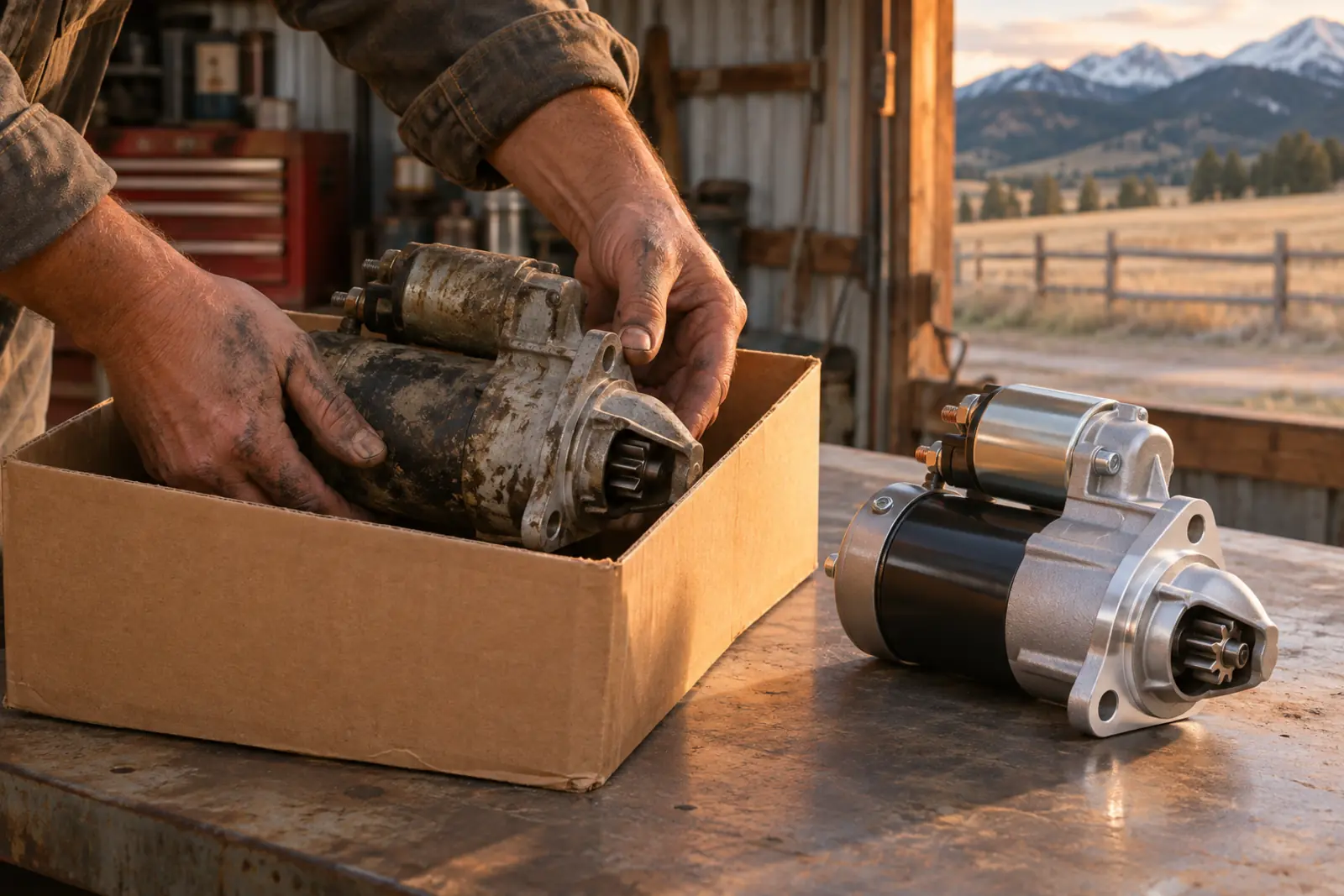
A core charge is a refundable deposit added to the price of a remanufactured part, and you get it back when you return your old, worn-out part (the "core") in good enough condition. The seller needs your old unit to rebuild the next one, so the deposit is credited back once the core is accepted. Returns on parts usually have to be unused, uninstalled and in original packaging, and electrical parts are often non-returnable once opened. Warranties differ widely, so the three things to read before paying are the length, what the warranty covers (the part only, or labor too) and who you deal with when something goes wrong.
What is a core charge, and why does it exist?
Alternators, starters, brake calipers, steering racks, turbochargers, AC compressors and some transmissions are rebuilt from used units. The rebuilder needs your old part to make the next one, so the seller collects a deposit up front. The deposit is not a fee. It is credited back when the core comes in.
The size of a core charge depends on the part. A small starter may carry a modest deposit, while a transmission or hybrid battery core can be a large sum. Always check the number before you check out, because some listings show the price with the core charge already added and some show it separately.
Core charge meaning in plain terms
"Core" is the trade word for a used part that can be rebuilt. "Core charge", "core deposit" and "core return" describe the same arrangement: you pay extra now, and the extra comes back when the old part does. If you buy a brand-new part rather than a remanufactured one, there is usually no core charge, though a few new parts are still sold with one. The product page or the receipt will show it as a separate line.
Core charge on an alternator or starter
Alternators and starters are among the parts most often sold with a core charge, because both are routinely rebuilt rather than scrapped. The deposit on each is set by the seller and differs by vehicle, so there is no single figure to quote. What matters is the same on both parts: the old unit must come back complete and not broken open, in the box the new one came in if possible.
- Alternator core. Bring back the unit you removed, not a different one. A cracked housing or heavy damage can lead the seller to refuse it.
- Starter core. The same rule applies. Do not disassemble it, and check the seller's rules on parts that were burned or water-damaged.
- Both. If the new part fails to fix the problem, the cause may be elsewhere, such as a weak battery. The guide to the car battery in cold weather shows how to test before you replace a charging or starting part.
How to get your core charge back
- Ask about the policy first. Find out how long you have, where the core must be returned and whether you need the original receipt.
- Keep the box. The new part's packaging is the best way to ship or carry the old part back safely. Many sellers want the core in the same box.
- Return it complete. A core with missing pieces, a cracked housing or fire or water damage may be rejected. Do not take the unit apart.
- Drain fluids if told to. Steering racks, calipers and compressors can leak. Follow the seller's instructions for draining and sealing ports.
- Get proof. Keep the return slip or shipping receipt until the refund shows up on your card.
If the part you are replacing is not the same type as the one you bought, such as a rebuilt unit with different mounting, the core may be refused. Matching the part to your vehicle first is the best protection; the guide to finding parts by VIN covers the steps.
Core charge refund: how long it takes and what can go wrong
Timing is set by the seller. Some refund at the counter when you hand over the old part with the receipt, while online orders usually wait until the returned core has arrived and been inspected. Ask for the deadline in days when you order, because a core brought back late may not earn a refund. If the refund does not appear, send the tracking or return slip in writing and ask for a status.
The most common reasons a core is turned down are a different part type, missing or broken pieces, and damage beyond normal wear. Parts that fail for ordinary reasons, such as a worn alternator or a starter with a dead motor, are what rebuilders expect to receive.
Return policies you will meet
| Seller type | Common return terms | What to confirm |
|---|---|---|
| National parts retailer (store or online) | Unused, uninstalled parts in original packaging, often within 30 to 90 days; receipt required | Restocking fees, special-order rules, whether returns go to the store |
| Dealer parts counter | Often shorter; electrical parts frequently final sale | Which categories are non-returnable |
| Online marketplace seller | Set by the individual seller or the platform | Who pays return shipping; the platform's buyer protection |
| Salvage yard | Short exchange window, often 30 days; some parts sold as is | Exchange only or refund, labor coverage |
Treat the table as typical patterns, not promises. Policies change, so read the one that applies to your order.
Electrical parts and the no-return trap
Sensors, modules, relays and many other electrical parts, sometimes including alternators and starters, are often non-returnable once you have opened them, because an installed part can be damaged by a fault in the vehicle and look defective afterward. If a new sensor fails right away, there may be a wiring problem or a failed upstream part. Before you swap anything electrical, test the circuit or have a technician confirm the diagnosis. That small cost is usually cheaper than buying the wrong part twice.
Note that the "no returns" rule applies to the part, while the core deposit is a separate matter. Even if the new electrical part cannot go back, the old core is normally handled under the seller's core terms, so ask whether the deposit is still refundable.
Reading a warranty properly
A part warranty is only as useful as its terms. Look for these points:
- Length. Thirty days, 12 months, 36 months, and "limited lifetime" are all common. Lifetime usually means for as long as you own the vehicle, and only for the original buyer.
- Replacement or refund. Most warranties replace the part, or refund its price. Few cover the labor you paid to install it unless that is written down.
- Exclusions. Commercial use, racing, damage from other failed parts and incorrect installation are common exclusions.
- Proof of purchase. Keep the receipt, the part number and the date of installation. A photo of the installed part and the mileage is a good habit.
- Who handles the claim. A manufacturer may send you to the retailer, and a retailer may point back to the manufacturer. Ask who to contact.
Warranty on used parts is different. A salvage yard may give 30 to 90 days, sometimes with the option to exchange for another part rather than receive a refund, and some parts are sold as is. The guide to buying a used engine or transmission goes through the terms to demand when the part is expensive.
Brake parts deserve extra care. A rebuilt caliper often carries a core charge, and a failure on a long grade is a safety issue, so read the warranty before you buy. The guide to brakes for mountain descents explains why in mountain driving.
Warranty on the car itself
If the vehicle is still under its factory warranty, check with the dealer before installing aftermarket parts. According to Federal Trade Commission guidance, using aftermarket or recycled parts does not by itself void a vehicle warranty, but a claim can be denied if the part caused the damage. Keep service records either way. The guide to OEM, aftermarket, used and remanufactured parts has more on choosing between types.
What to do when a part fails
- Stop driving if the failure affects brakes, steering or overheating.
- Photograph the part, the receipt and the installation.
- Contact the seller in writing and say what happened, with the date and mileage.
- If the seller does not respond, ask your card issuer about a dispute, and note that deadlines for disputes are limited.
- For a suspected unsafe defect, report it to the National Highway Traffic Safety Administration.
If a seller is not responding at all, the cause may be a bogus shop. See how to spot fake auto parts websites before the next order.
Frequently Asked Questions
What does core charge mean on an auto part?
It is a deposit included in or added to the price of a remanufactured part. You pay it at purchase and receive it back when you return your old part. It is a deposit, not a fee.
Is a core charge refundable?
Yes, as long as you return an acceptable core under the seller's terms. Check the deadline, whether you need the receipt and whether the core must be returned in the new part's box.
What happens if I lose the old part and cannot return the core?
You usually keep paying the core charge, because the deposit is only refunded when the old unit comes back. Ask the seller whether a different core of the same type is acceptable before you give up on the deposit.
Can I return a part after I have installed it?
Often not. Most sellers only accept unused, uninstalled parts in original packaging. A defective part may be covered under warranty instead, which is a different process from a return.
Does a part warranty cover my labor?
Usually it does not. Most warranties cover only the part itself, sometimes only as a replacement. Labor coverage exists for some shop installations and some premium products, but it should be written in the terms.
Is a core charge the same as a deposit on a battery?
It works the same way. Car batteries commonly carry a core charge refunded when you return the old battery, and retailers often take the old one at the counter. Confirm the amount and the rules before you buy.
Who pays for return shipping?
It depends on the seller and on the reason. Many sellers cover shipping for wrong or defective items, while change-of-mind returns usually cost the buyer. Check the policy before ordering a heavy part.