Independent guide · Granby, CO
Auto Parts and Winter Car Care in Granby, CO: An Independent Guide
An independent guide to choosing auto parts and keeping a car running through Grand County winters, altitude and mountain passes, with checklists.
This is an independent guide to buying auto parts and keeping a vehicle running in Granby, Colorado and the rest of Grand County. It covers two things that tend to go together in the mountains: the practical know-how of buying the right part at a fair price, and the winter and altitude problems that wear cars out faster here than in a city at sea level. The guides are written to be read before you spend money, not to sell you anything.
The site is not a store. It does not stock, sell, order, ship or quote parts, and it cannot take payments. It explains how things work so that you can deal with real shops, national retailers and salvage yards on better terms.
Why a guide for this corner of Colorado
Granby sits at roughly 8,000 feet in the Middle Park basin, on US-40 about 85 miles northwest of Denver. Winters are long and cold. Nearby routes climb much higher: Berthoud Pass on US-40 reaches about 11,300 feet, and Trail Ridge Road in Rocky Mountain National Park peaks at 12,183 feet before closing for the season, typically from mid-to-late October until late May. Vehicles here face cold starts, long grades, thin air, strong sun and road treatments that eat metal. Generic car advice rarely covers all of that.
Rules for new drivers vary as much as the terrain. New York, for example, requires most learners to complete a five hour driving class before they can schedule a road test, and the class can be taken live online.
Buying parts: the basics
Most wasted money on parts comes from three mistakes: buying the wrong part, buying the wrong type, and buying from the wrong seller. These guides address each in turn.
- OEM, aftermarket, used and remanufactured parts explains the four categories and when each one makes sense.
- Finding the right part with your VIN shows how to confirm fit before you pay.
- Core charges, returns and warranties decodes the fine print that decides whether a refund is possible.
- How to spot fake auto parts websites is a checklist for avoiding sellers that take payment and never deliver.
- Buying a used engine or transmission covers the highest-stakes purchase most drivers will ever make.
Cold, snow and the passes
Winter is where mountain drivers get caught out, and where the right parts matter most.
- Car batteries in extreme cold explains cold-cranking amps, testing and replacement.
- Winter tires and Colorado's Traction Law summarizes the rules published by the Colorado Department of Transportation and how to choose tires.
- Engine block heaters and cold starts covers heaters, oil grades and starting habits.
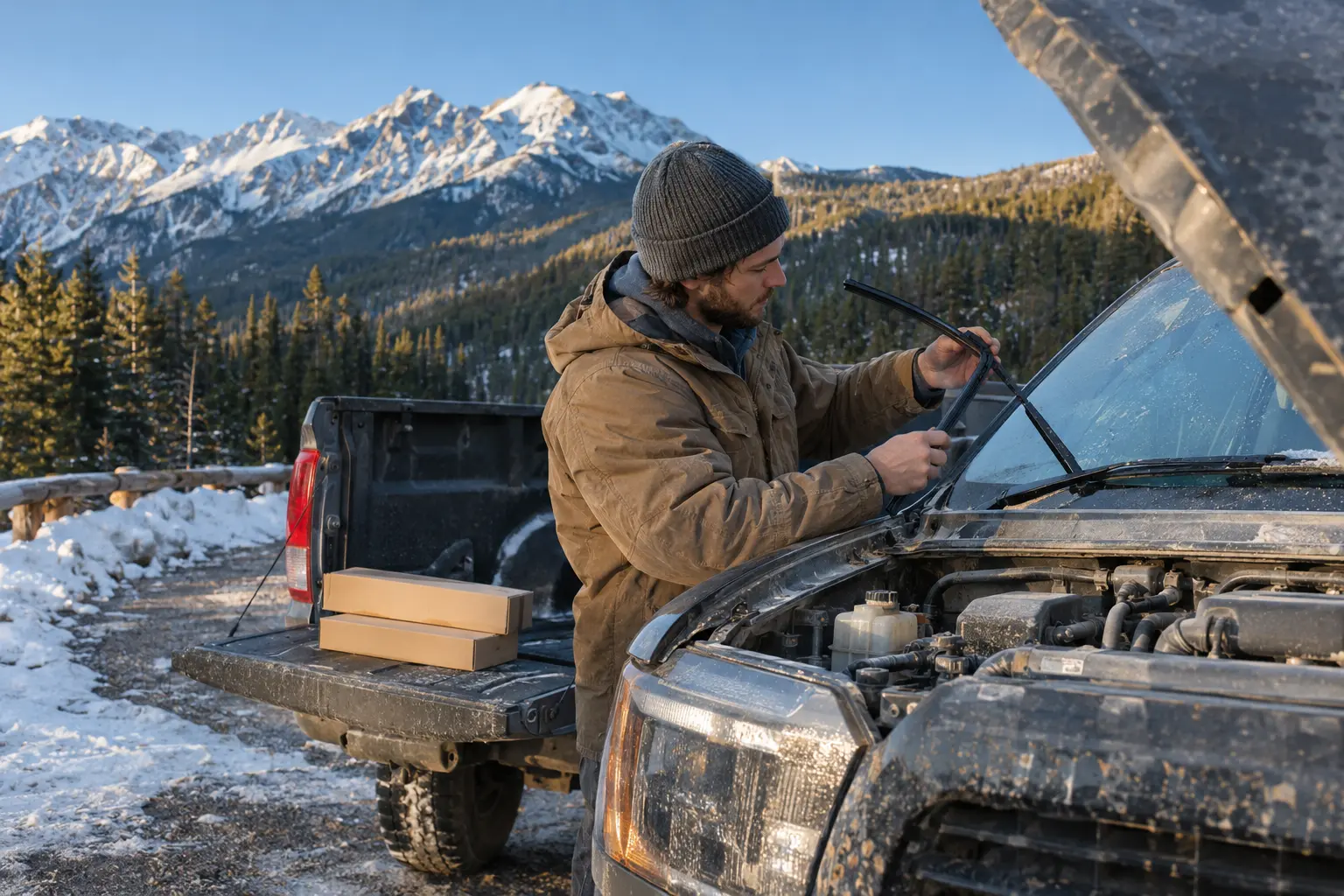
- Wipers, washer fluid and winter visibility deals with seeing the road when it is full of snow and spray.
- Road deicers and underbody rust explains how brine attacks brake lines and frames and how to rinse and inspect.
Altitude, climbs and descents
Thin air and steep grades change how engines, cooling systems and brakes behave.
- Altitude, engines, cooling and tire pressure explains what thin air does to power, why the radiator cap matters and why tire pressure drops in the cold.
- Brakes for mountain descents describes fade, brake fluid and the technique that protects the pads.
A plan for the year
If you read only one page, make it the winter parts checklist for Grand County drivers. It turns the other guides into a fall, winter and spring routine, including an emergency kit for the road.
From mountain winters to Florida rain
Most of this guide is about cold: batteries that struggle at dawn, brine on the underbody and traction rules on the passes. Grand County residents who move to South Florida, or spend the winter there, leave those problems behind and meet new ones, from heavy summer downpours to six-lane roads and fast interstate merges.
Drivers who become Florida residents have 30 days to switch to a Florida license. Teenagers start with a learner's license at 15, after the 6-hour DETS course and the knowledge exam, and drive only in daylight for the first three months. Adults who have never held a license take the 4-hour TLSAE course instead.
In Palm Beach County, PalmWay, a driving school licensed by the Florida Department of Highway Safety and Motor Vehicles, gives driving lessons in Lake Worth Beach in late-model dual-control cars, with door-to-door pickup from home, work or school. Practice starts on Lake Worth Road, Olive Avenue and Sixth Avenue South and moves on to Dixie Highway, I-95 and the Florida Turnpike when the student is ready.
How the guides are written
Every page starts with the short answer and then gives the reasoning, so you can stop reading when you have what you need. Where a law or rule is involved, the guide points to the official source, such as the Colorado Department of Transportation or the Federal Trade Commission, and tells you to verify current details before you act. Prices appear only as rough ranges for orientation. When a fact could not be confirmed, it was left out.
The advice is general. Your vehicle's owner's manual, a qualified technician and the seller's written terms always take priority over anything here. If you spot an error or have a suggestion, use the contact page, and read about this guide for how the site works and what it is not.